
PFAS Remediation Explained: Effective Treatment Options for Soil and Water

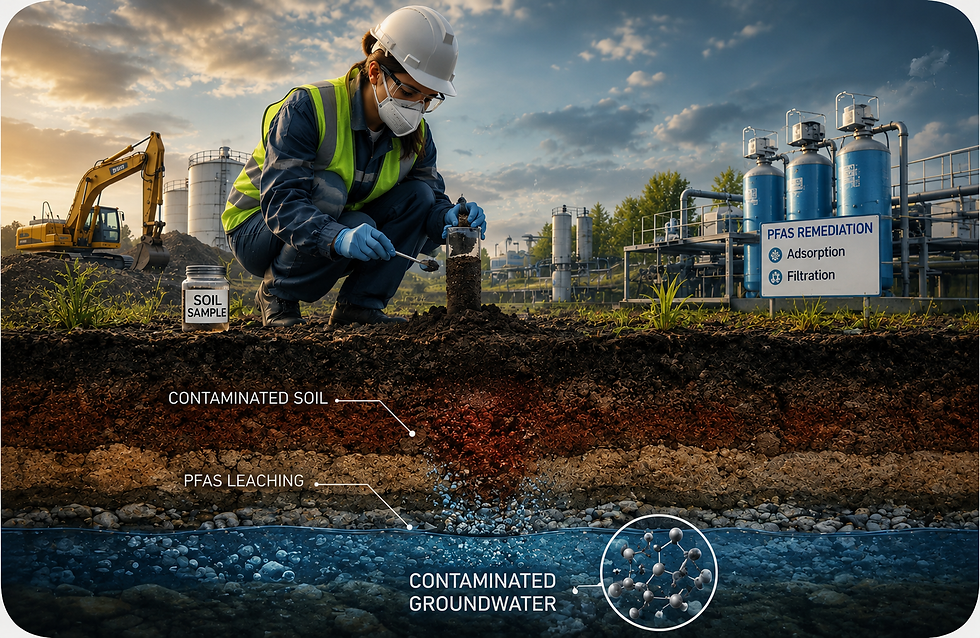
PFAS, often referred to as “forever chemicals”, are a group of synthetic compounds known for their extreme resistance to heat, water, and chemical breakdown. While these properties made them valuable in industrial applications for decades, they have also created serious environmental challenges. Today, PFAS contamination is affecting soil, groundwater, and drinking water systems worldwide.
Because these chemicals are highly mobile and remain stable for decades, managing them has become a major challenge for industries, regulators, and local communities alike.
As environmental standards tighten globally, the demand for effective and sustainable PFAS remediation strategies continues to increase. From established adsorption technologies to emerging destruction methods, organisations are now exploring solutions that can manage both the mobility and persistence of PFAS contamination.
Understanding PFAS Contamination
PFAS contamination is most commonly linked to industrial facilities, airports, defence sites, and wastewater operations. One of the best-known sources is aqueous film-forming foam (AFFF), which has been widely used for firefighting activities over the years.
What makes these chemicals particularly difficult to manage is their chemical stability. PFAS compounds contain extremely strong carbon-fluorine bonds, allowing them to persist in the environment for extended periods without naturally degrading. Over time, this can spread contamination well beyond the original source area, creating long-term environmental and regulatory concerns. Because PFAS are both mobile and highly persistent, remediation efforts need to focus on limiting their movement while also reducing contamination levels over time.
Key PFAS Treatment Technologies
Several proven treatment methods are available to help manage and remediate PFAS contamination:
Activated Carbon Adsorption
Activated carbon remains one of the most widely used approaches for PFAS filtration and treatment. The process relies on adsorption, where PFAS molecules attach to the surface of the carbon as contaminated water passes through the system.
Granular Activated Carbon (GAC) is commonly used in municipal and industrial treatment applications, particularly for longer-chain PFAS compounds. Factors such as contact time, pore structure, and water quality can all influence overall performance.
Bygen produces sustainable activated carbon using its patented Low-Temperature Activation (LTA) technology, helping reduce energy consumption compared with conventional activation methods. Solutions such as Bysorb EarthTM are designed specifically for PFAS remediation projects involving contaminated soil and environmental clean-up applications. Additionally, Bysorb AquaGuard is engineered for water treatment systems, providing effective adsorption of PFAS and other emerging contaminants in municipal and industrial water streams.
One reason activated carbon remains widely used is its ability to deliver reliable PFAS treatment performance at a commercial scale. However, like any filtration media, spent carbon eventually needs regeneration or replacement.
Ion Exchange Resins
Ion exchange resins work by attracting and capturing PFAS compounds using charged resin beads. These systems can be especially effective for shorter-chain PFAS compounds that may be more difficult to remove through activated carbon alone.
Although highly efficient, ion exchange systems can involve higher operating costs and more complex waste management processes.
Reverse Osmosis and Membrane Filtration
Reverse osmosis and membrane filtration systems physically separate PFAS from water using specialised filtration barriers. These technologies are often used where very high water quality standards are required. While the PFAS removal efficiency can be extremely high, these systems generally require significant energy and can produce concentrated waste streams that must be carefully managed.
Destruction Technologies
Newer technologies are now being developed to permanently destroy PFAS compounds instead of simply separating them from water or soil. These include plasma oxidation, thermal treatment, and electrochemical oxidation.
Although promising, many of these technologies are still expensive and not yet widely scalable for large remediation projects.
Moving Towards Sustainable PFAS Remediation
As awareness of PFAS contamination continues to grow, industries are placing greater importance on treatment solutions that support long-term sustainability as well as performance. Businesses are increasingly evaluating not only treatment performance but also environmental impact.
Activated carbon remains one of the most proven and scalable technologies for PFAS remediation and water treatment. At the same time, the industry is seeing a shift towards renewable biomass feedstocks, lower-emission production methods, and regeneration strategies that help reduce environmental impact. This growing focus on sustainable activated carbon solutions reflects a broader move towards cleaner and more circular remediation practices.
Conclusion
PFAS contamination is a complex issue that cannot be solved with a one-size-fits-all approach. Every site comes with different environmental conditions, contamination levels, and treatment requirements, which is why selecting the right remediation strategy is so important.
As technologies continue to evolve, the focus is shifting towards solutions that deliver effective PFAS removal while supporting long-term environmental sustainability. For many applications, activated carbon continues to play a key role because of its proven effectiveness, scalability, and adaptability across both soil and water treatment projects.


